
BIODIVERSITY F.A.Q. (MCQUEEN REMIX)
What is biodiversity?
Derived from the word biological diversity, biodiversity was a term first coined in the mid 1980’s. Biodiversity generally represents the variation of life from ecological diversity to genetic diversity within a species, to the vast array and diversity of species observed and unobserved on the planet. Biodiversity has come to also encompass the processes, systems and interactions that produce and maintain the variety of life. In addition, biodiversity can skirt having an objective scientific definition as it is laden with both economic and cultural values. How and when we choose to use the term biodiversity is intrinsic to the value we place on it and our particular definition.
What is the state of biodiversity?
It is globally accepted that biodiversity is declining in a rapid fashion. As humans moved from a foraging to an agricultural society, we set in motion great rearrangements of both land and water systems. As our technology grew, our short-term sense of well-being also improved. But as our cities kept growing, we experienced a schism that unlinked our perception of well-being (in the city) to the state of the environment itself (outside the city). Consequently, we have continued to create great pressures on the ecosystems. We alter the chemical balance of our environment by releasing tons of sequestered carbon. We submit to globalization and the redistribution of land use and water supply, in effect drastically altering the variety of life and its ability to provide natural assets. It is estimated that our species has increased the natural rate of extinction by 1000 times, a rate that is unprecedented. Our fellow mammals will lose 25% of their kind in the next century. Most pressing, is the realization that with a decrease in genetic diversity and habitat, life could become ill-equipped to deal with the pressures of current global change.
What are biodiversity hotspots?
It was in 1988 when Norman Myers introduced the term hotspot to define ten tropical forest regions that had a large number of endemic plant species facing extinction. Since then the hotspot concept has been used by Conservation International, as well as a multitude of others, to identify regions with large endemic populations of vascular plants (at least 1500 species) and more than 70% of its original habitat lost. The idea being that scarce conservation funding can be focused on these identified regions to preserve the greatest amount of biodiversity for the least amount of funds. In a 2005 report “hotspots revisited” Conservation International identified a total of 34 regions qualifying for hotspot status. The identified hotspots by Conservation International are as follows:
North and Central America
California Floristic Province, Caribbean Islands, Madrean Pine-Oak Woodlands
Mesoamerica, South America
Atlantic Forest, Cerrado, Chilean Winter Rainfall-Valdivian Forests, Tumbes-Chocó-Magdalena, Tropical Andes
Europe and Central Asia
Caucasus, Irano-Anatolian, Mediterranean Basin, Mountains of Central Asia
Africa
Cape Floristic Region, Coastal Forests of Eastern Africa, Eastern Afromontane, Guinean Forests of West Africa, Horn of Africa, Madagascar and the Indian Ocean Islands, Maputaland-Pondoland-Albany, Succulent Karoo
Asia-Pacific
East Melanesian Islands, Himalaya, Indo-Burma, Japan, Mountains of Southwest China, New Caledonia, New Zealand, Philippines, Polynesia-Micronesia, Southwest Australia, Sundaland, Wallacea, Western Ghats and Sri Lanka
Are there problems with the hotspot theory?
Some wonder if limiting resources to these select areas is really the best method to preserve biodiversity. Hotspots are measured by either the number of total species, the number of endemic species, or the number of rare/ threatened species. Identifying hot spots by these three different criteria produces disjointed maps of areas in need. Hotspots as identified through the total number of endemic species like those defined by Conservation International have been demonstrated to overlap best with hotspots as defined by the other two measurements. These areas with high levels of endemism are also areas with high levels of speciation. Preserving these areas would not only preserve the vast array of species that now exists but also the process of speciation that is required for the future survival of life forms. There are other criteria one could measure outside number of species to identify hotspots. Maps derived from other criteria such as types of habitat produce a much different view of areas of conservation priority. Deciding which maps represent the most important areas of need is a value based decisions and differs at local to global levels.
The identification of hotspots is also intimately related to the collection of data, analysis and conservation theory. Data collection is not always uniform and incomplete taxonomy is an obstacle. The development and standardization of conservation tools is essential to identify areas of immense biodiversity. As the science of conservation is recent much development is required. New fields such as conservation biogeography will play an important role in the development of conservation planning frameworks. Conservation theories and methods must be available for critical analysis and debate to improve our conservation plans.
Are hotspots the only way to preserve biodiversity? – The Millenium Ecosystem Assessment.
In recent years, it has been suggested that the simplified hotspot approach misses the importance of the breadth of biodiversity and its many impacts on our own species. At its most belittling, it has been compared to collecting butterflies. Although preservation of all these 34 areas of great number of endemic species would be a remarkable step forward, with limited resources we must wonder if it will be enough.
The millennium ecosystem assessment issued by the United Nations in 2000 and published in March 2005 comments on the relationship between the ecosystem and human well-being. The basic provisional roles that ecosystems provide such as food, shelter, water, fiber and fuel are easily accounted for. Yet, the true value of ecosystems is far greater. Through provision, regulation, and cultural services, ecosystems contribute to human being through security, basic materials, health and social relationships. A poignant interplay between human well-being and ecosystems was demonstrated by the immense loss of life due to the Indian Ocean tsunami of 2004. With one third of the world’s mangrove forests removed, little security was offered to coastal peoples from such natural disasters. If we account for the true economic value of our natural assets we would not trade them so cheaply.
For example, a study in 2004 by Ricketts et al. determined that forest areas preserved around a coffee bean plantation led to the production of higher yields and healthier beans. In this case, the surrounding forests had a larger economic value left intact than could have been gained by deforestation and conversion to agricultural land. Assigning monetary value on the environment appears as an appropriate way to obtain recognition from an economy focused world. It is suspected that if we do put a truly reflective monetary value on the environment we will be forced to protect it. Decisions will still have to be made on issues such as the conversion of land to agriculture and cases will not always be as simple as the one demonstrated above. We must wonder if we promote the image of the environment with a price tag, will we begin to trade it like a commodity and lose forever a reverence for nature in its own right.
The millennium ecosystem assessment draws attention to three important changes that are believed to preserve our well being and in so doing conserve biodiversity in its fundamental role in providing natural assets. First, we must include the true value of ecosystem services into all economic decisions. Secondly, empowering communities with a role in decision over natural assets will foster care for the immediate environment. Thirdly, recognition of ecosystem importance at all levels of government and business will create disseminate the responsibility of protection. These three suggestions require education and changes in policy making from every level. But with these lessons learned we are perhaps better armed for creating a sustainable future.
Bibliography
1. Biodiversity Hotspots. 2005, Conservation International. http://www.biodiversityhotspots.org/xp/Hotspots/
2. Hirsch, T., Living Beyond Our Means; Natural assets and human well-being. 2005, United nations.
3. Odling-Smee, L., Conservation: dollars and sense. Nature, 2005. 437(7059): p. 614-6.
4. Possingham, H.P. and K.A. Wilson, Biodiversity: turning up the heat on hotspots. Nature, 2005. 436(7053): p. 919-20.
5. Ricketts, T.H., et al., Economic value of tropical forest to coffee production. Proc Natl Acad Sci U S A, 2004. 101(34): p. 12579-82.
6. Whittaker, R. et al., Conservation biogeography: assessment and prospect. Diversity and Distributions, 2005. 11: p. 3-23.
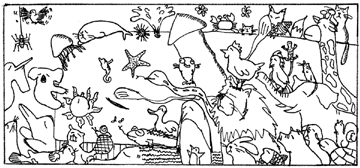
(artwork by Stephanie Cheung)
